The best famous artists for kids are the ones whose paintings have something to find: Van Gogh's swirls, Chagall's floating goat, Frida Kahlo's monkey, Hockney's splash. Below are twelve very different painters, from Vincent van Gogh to Jean-Michel Basquiat, each with a short story a child can follow, one famous painting to look at together, what to look for in it, and a question to ask your child.
These are the same twelve artists in the Museme personalized art book we make, and the stories and questions come from the artist pages in that book. You do not need the book to use this list: every artist and painting here can be found in a library art book, and most of the museums that own them show them on their websites.
How to look at a famous painting with a child
You do not need to know anything about art history. Three steps work for almost any painting and any child from about three up.
- Look quietly for ten seconds. Count them out loud if it helps. Children notice more than adults once they slow down.
- Ask "What do you see?" before you explain anything. Accept every answer. A child who says "a scary face" has found something real about the picture.
- Ask one question that has no right answer. Each painting below comes with one. The goal is a conversation, not a quiz.
The 12 artists at a glance
| Artist | Painting | Year | Where it is | Look for |
|---|---|---|---|---|
| Vincent van Gogh (Netherlands) | The Starry Night | 1889 | Museum of Modern Art, New York | Swirling sky, thick paint |
| Claude Monet (France) | Water Lilies | 1914–1926 | Musée de l'Orangerie, Paris, and other museums | A pond with no horizon |
| Gustav Klimt (Austria) | The Kiss | 1907–1908 | Belvedere, Vienna | Gold, spirals and flowers |
| Frida Kahlo (Mexico) | Self-Portrait with Thorn Necklace and Hummingbird | 1940 | Harry Ransom Center, Austin, Texas | A monkey, a black cat, a hummingbird |
| Pablo Picasso (Spain) | Three Musicians | 1921 | Museum of Modern Art, New York | People made of flat shapes |
| Jean-Michel Basquiat (USA) | Untitled (Skull) | 1981 | The Broad, Los Angeles | A head you can see inside |
| Marc Chagall (Russia/France) | I and the Village | 1911 | Museum of Modern Art, New York | An upside-down woman, a goat |
| David Hockney (England) | A Bigger Splash | 1967 | Tate, London | The splash, and nobody in sight |
| Lucian Freud (England) | Interior at Paddington | 1951 | Walker Art Gallery, Liverpool | A man and a very large plant |
| Alice Neel (USA) | Andy Warhol | 1970 | Whitney Museum of American Art, New York | Bare canvas she left unpainted |
| Tamara de Lempicka (Poland/USA) | Self-Portrait (Tamara in the Green Bugatti) | 1929 | Private collection | A green car, gloves, no brushmarks |
| Amrita Sher-Gil (India/Hungary) | Three Girls | 1935 | National Gallery of Modern Art, New Delhi | Three faces, warm colors |
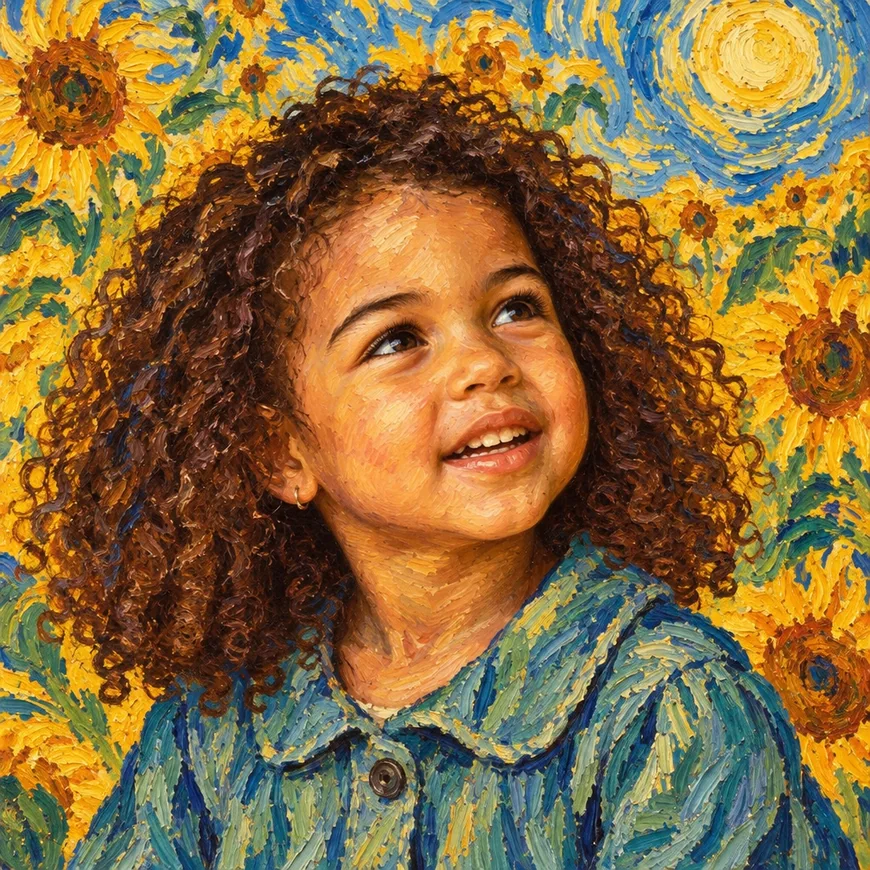
1. Vincent van Gogh (1853–1890): The Starry Night
Van Gogh squeezed paint straight from the tube onto the canvas, so thick you could feel the ridges with a finger. He painted The Starry Night in 1889, from the view out of his window at a hospital in Saint-Rémy, in the south of France, and added a sleeping village and a tall, dark cypress tree. In his whole life he sold almost nothing; today The Starry Night is one of the most famous paintings in the world.
Look for: the sky. Nothing in it sits still: the stars have rings around them and the wind curls like waves.
Ask your child: "Could the thick brush strokes actually be moving in the wind?"
2. Claude Monet (1840–1926): Water Lilies
Monet dug a pond in his own garden at Giverny, planted water lilies in it, and then painted that same pond more than two hundred times, in fog, at sunrise and in high summer, because the light was never once the same. The biggest are eight huge panels that wrap around two oval rooms at the Musée de l'Orangerie in Paris.
Look for: where the sky is. There is no horizon; the clouds are reflections in the water.
Ask your child: "Look at the gentle colors. Do you feel like you are standing in a garden?"
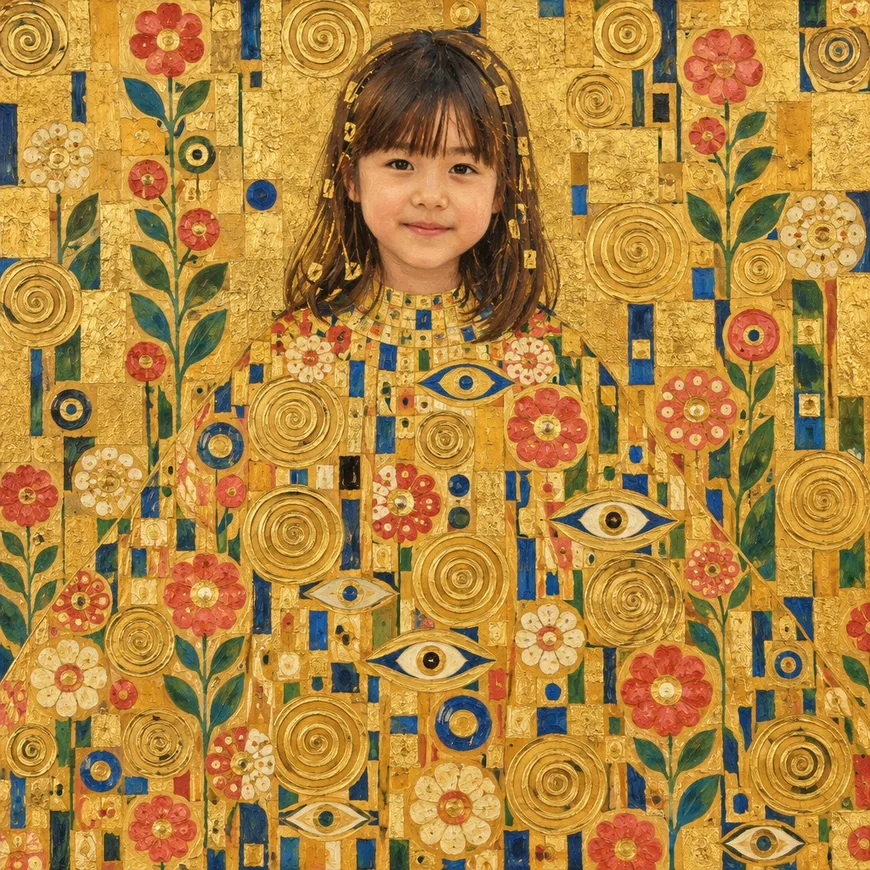
3. Gustav Klimt (1862–1918): The Kiss
Klimt covered his paintings in gold: real gold, beaten into sheets thinner than a leaf and pressed onto the canvas. In The Kiss, two people are wrapped in robes so full of spirals, squares and flowers that you can hardly tell where the people end and the pattern begins. It hangs in the Belvedere in Vienna.
Look for: the two kinds of pattern. One robe has rectangles; the other has circles and flowers.
Ask your child: "Do you see the gold and silver shapes? What patterns can you find?"
4. Frida Kahlo (1907–1954): Self-Portrait with Thorn Necklace and Hummingbird
Kahlo painted herself more than fifty times, usually looking straight out at you and not smiling. She put her pets in the pictures with her: monkeys, a little deer, parrots. In this 1940 self-portrait, a spider monkey sits behind one shoulder and a black cat behind the other, with big green leaves all around her. It belongs to the Harry Ransom Center at the University of Texas at Austin.
Look for: the monkey, the cat and the hummingbird on her necklace. Then look in her hair.
Ask your child: "Frida loved animals and nature. Which animal would you put in your painting?"
5. Pablo Picasso (1881–1973): Three Musicians
Picasso could already draw like a grown-up when he was a child, and he spent much of his life finding new ways to break the rules. In Three Musicians (1921), a clown, a harlequin and a monk are built out of flat shapes that look like cut paper, and a dog stretches out under the table. The version at the Museum of Modern Art in New York is taller than a grown-up.
Look for: the dog. Then look for the musicians' hands: they are tiny.
Ask your child: "The shapes are all mixed up! What funny shapes do you see?"
6. Jean-Michel Basquiat (1960–1988): Untitled (Skull)
Basquiat was writing on walls around New York before he ever showed a painting in a gallery. He drew a three-pointed crown over the people he admired, kept his lines rough, and crossed words out on purpose so that you would want to read them. His 1981 Untitled is a huge head where you can see the face and what is inside it at the same time. It is at The Broad in Los Angeles.
Look for: which parts look like a face and which look like the inside of a machine.
Ask your child: "Basquiat loved bright colors and energetic lines. What colors would you use to show your energy?"
7. Marc Chagall (1887–1985): I and the Village
In Chagall's paintings, people float. They drift over the rooftops, sometimes upside down, with a goat or a fiddler up in the sky beside them. He was painting the village he grew up in, the way you remember a place in a dream. In I and the Village (1911), a green-faced man looks at a goat, and inside the goat's head a small woman is milking a small goat.
Look for: the upside-down woman and the upside-down houses.
Ask your child: "If you could float above your town, what would you see?"
8. David Hockney (1937–2026): A Bigger Splash
Hockney moved to sunny California and painted swimming pools. The hardest thing, he said, was a splash: a splash is over in half a second and took him two weeks to paint. In A Bigger Splash (1967), someone has just dived in, and all we see is the water jumping up beside an empty chair. It hangs at Tate in London. Much later he painted on an iPad with his thumb.
Look for: the diver. You cannot see them; the splash is the only clue.
Ask your child: "If you could paint your room any color, what would you pick?"
9. Lucian Freud (1922–2011): Interior at Paddington
Freud made people sit for him for hundreds of hours, until he knew their face better than they did. He flattered nobody, not even the Queen, who sat for him too. In Interior at Paddington (1951), a man in a raincoat stands beside a potted yucca plant almost as tall as he is, one fist clenched. It is at the Walker Art Gallery in Liverpool.
Look for: the man's face. Is he happy, worried or bored? Then look at his hand.
Ask your child: "If someone painted your face really big, what expression would you make?"
10. Alice Neel (1900–1984): Andy Warhol
Neel painted her neighbors, whoever came up the stairs and knocked. She never made anyone prettier than they were, and she often left part of the canvas bare, so you can see exactly where she stopped. In 1970 she painted the artist Andy Warhol sitting with his eyes closed, showing the scars from an operation. The painting is at the Whitney Museum of American Art in New York.
Look for: the couch. It is only an outline; she never filled it in.
Ask your child: "Alice Neel painted people just as they really are. What makes you special and unique?"
11. Tamara de Lempicka (1898–1980): Self-Portrait (Tamara in the Green Bugatti)
Lempicka painted people as if they were carved from something hard and then polished: no brushmarks anywhere, just smooth color meeting at sharp edges. She loved fast cars, and in 1929 she painted herself driving a green one, wearing gloves and a leather helmet, for the cover of a German fashion magazine. The painting is in a private collection.
Look for: how shiny everything looks, even her skin and her scarf.
Ask your child: "Tamara loved bold shapes! Can you make a diamond shape with your hands?"
12. Amrita Sher-Gil (1913–1941): Three Girls
Sher-Gil learned to paint in Paris, then went home to India and painted the people around her in flat, warm colors. Three Girls (1935) shows three young women sitting close together in deep reds and greens, none of them smiling. It won a gold medal in Bombay in 1937 and is now at the National Gallery of Modern Art in New Delhi.
Look for: which girl looks happiest, and which looks like she is thinking.
Ask your child: "Amrita painted with warm, glowing colors. What warm color makes you feel happy?"
Turn it into an activity
- Painting hunt. Print small copies of three paintings from the list and hide them around the house. When your child finds one, ask the question for that painting.
- Copy one detail. Pick one thing, such as Van Gogh's swirl, Klimt's spiral or Hockney's splash, and draw only that, as big as the paper allows.
- Put yourself in the picture. Ask your child to draw themselves inside one painting: floating over Chagall's village, sitting by Hockney's pool, or next to Frida's monkey.
That last activity is the idea behind the Museme personalized art book. From one photo, your child is painted into twelve pictures inspired by these twelve artists, each beside a page about the artist and the question above, asked by name. It is a 32-page hardcover for ages 3–10, and you approve every page before anything prints.
FAQ
Who are the most famous artists for kids to learn about?
Start with painters whose pictures give a child something to find: Vincent van Gogh, Claude Monet, Frida Kahlo, Pablo Picasso, Marc Chagall and David Hockney. Their paintings have swirls, animals, floating people and splashes that young children can point at.
What are good famous paintings to show kids?
Paintings with something to find work best. The Starry Night (swirls), Klimt's The Kiss (gold patterns), Frida Kahlo's self-portraits (animals), Chagall's I and the Village (floating people) and Hockney's A Bigger Splash (the splash) all give a child something to point at.
At what age can kids start learning about famous paintings?
From about three, children can look and describe what they see; short questions work better than facts at that age. From six or seven, they enjoy the stories behind the paintings and can try copying a detail.
Where can kids see these paintings in real life?
Four of the twelve are in New York: The Starry Night, Three Musicians and I and the Village at the Museum of Modern Art, and Alice Neel's Andy Warhol at the Whitney. Others are in Paris, Vienna, London, Liverpool, Los Angeles, Austin and New Delhi.
How do I talk to my child about a painting?
Look quietly for ten seconds, ask what they see, then ask one open question such as "Which animal would you put in your painting?" Let the child lead; there are no wrong answers.